

【English Name】 L-Aspartic Acid
【Molecular Formula】 C4H7NO4
【Molecular Weight】 133.10
【CA Registry Number】 [1191-15-7]
【Abbreviations and Synonyms】 Asp and D
【Structural Formula】 HO2CCH2CH(NH2)CO2H
【Physical Properties】 (S)-(+): [α20D] +25°, mp >300 oC (decomposes); (R)-(–): [α20D] –24°, mp>300 oC (decomposes); (±): mp 325~348 oC (decomposes). It is soluble in acids and bases, insoluble in ethanol; its solubility in water is 1 g/222.2 mL (20 oC), and it readily forms supersaturated solutions [1]. 【Preparation and Commercial Use】 This reagent is a commercially available reagent, mostly racemic or optically pure white solid.
【Precautions】 This reagent is a natural product and is non-toxic.
L-Aspartic acid is commonly used as a chiral substrate for diastereoalkylation reactions and can also be used as a chiral source to synthesize other chiral compounds.
Diastereselective Alkylation
L-Aspartic acid esters can undergo alkylation at the α- and β-positions (Formula 1), with β-alkylation being the most widely used. In the β-alkylation process, the amino acid moiety has a significant impact on the diastereoselectivity of the reaction. Simultaneously, β-dicarbonyl compounds can also be prepared by β-alkylation of cyclic derivatives of L-aspartic acid. Diastereselective Alkylation
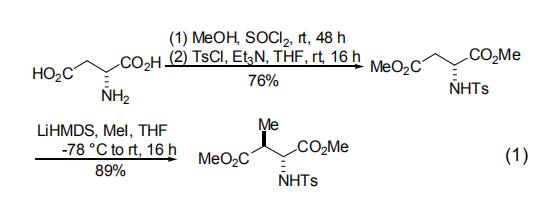
Synthesis of Chiral Compounds
Using L-aspartic acid as a chiral source, a series of chiral compounds can be synthesized. For example, using cuprous iodide, sodium borohydride, etc., can yield multifunctional oxo-nitrogen heterocyclic compounds (Equation 2), which can further generate quinoline compounds.
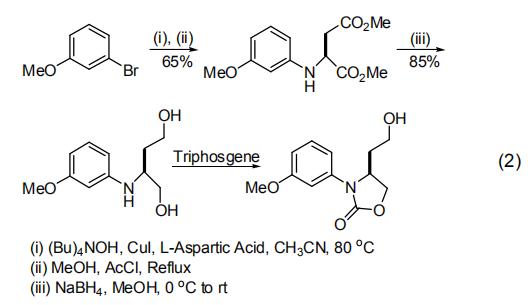
Synthesis of Chiral Compounds
Amide Bond Formation
L-aspartic acid, as an amino acid, can also generate amide compounds like other amino acids (Equation 3).
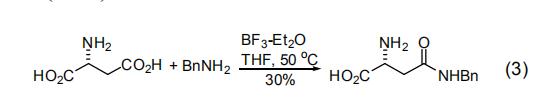
Amide Compounds
Simultaneously, L-aspartic acid can also be used as a parent compound to synthesize cyclic lactams, such as six-membered cyclic lactams (Equation 4). The product also contains alkoxy groups, which can serve as another reaction site for further derivatization.
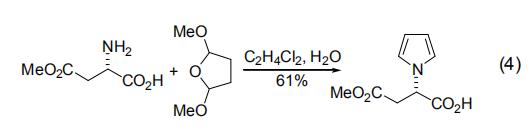
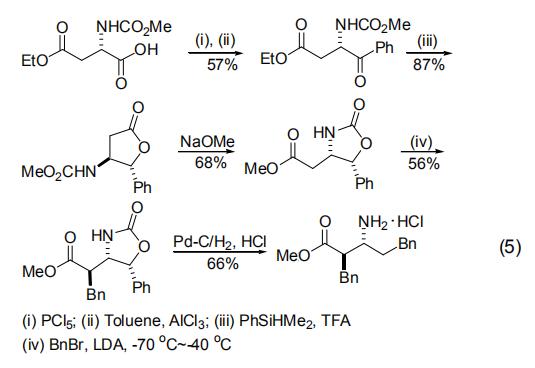
Synthesis of β-Amino Acids (or Amino Acid Esters)
L-aspartic acid, after amino protection and alkylation, can generate β-amino acids or amino acid esters (Equation 5). This reaction achieves the conversion from natural amino acids to non-natural amino acids. Synthesis of β-amino acids (or amino acid esters)
Furthermore, L-aspartic acid contains two carboxyl groups and one amino group, thus it can act as a polydentate ligand to coordinate with metal ions [7-9] or form lactone compounds itself.